HEM
Det låter som sommar
"Det låter som sommar" är en CD med
Ann-Mari och Sven Nordin, Haninge.
Ljuvlig musik på nyckelharpa men även; munspel, cittra,
gammelharpa, durspel, piano, mm.
Skivan är en slags musikalisk memoar över de senaste 20
spelmansåren. Inspelat 1997.
Skivan är slutsåld.
Upp.dat. 23 mars 2008 (Flyttad 8 augusti 2026)
Full mp3 files at the
bottom of this page !
Låtförteckning :
1/ Sorundamarschen. Sörmland Trad.
2/ Tegenborgsvalsen nr 2.
Lövsta bruk. Trad.
3
/ En gammal gumma sjöng denna låten. Trad.
4
/ Alla kullorna, bodapolska. Trad.
5/ Hamburgska C-dur.
Sörmland. Trad. 6
/ Leipzigs krigsmarsch. Trad.
7/ Farmors Hambo,
komp. Sven Nordin. Haninge.
8
/ Gammelpolska, komp. Sven Nordin.
Haninge. 9
/ Polska efter Kalle Svensk. Trad.
10/ Boda polska i
G-dur. Trad.
1
1/ Dunderhakens vals, efter Viktor Vikman. Österby
bruk. Trad. 1
2/ Polska i Arkadien, komp. Sven Nordin. Haninge.
1
3/ Svenne satt på taket, komp. Sven Nordin.
14/
Födelsedagsschottis till Sven, komp. Stefan Hagling, Skogås.
1
5/ Marsch efter Oscar Larsson, Uppsala. Trad.
16/
Födelsedagshambo, komp. Sven Nordin. Haninge. 1
7/ Vals efter
Viktor Vikman. Österby bruk. Trad.
18/ Gås-Anders A-durs
polska. Trad. 1
9/ Tranan, polska efter Byss Calle. Trad.
20/
Fermens polska. Trad.
21/
Kers Lars brudmarsch. Trad.
22/
Upplands-polska i E-moll. Trad.
23/Schottis efter Kalle Lind.
Vigelsbo Uppland. Trad. 2
4/
24/
Vallåt efter Henry Wallin. Trad. 25/
Var har du vari lilla Kari, Vispolska efter Henry Wallin. Trad.

foto Rolf Nordin,
Hässelby
Sven Nordin. Riksspelman. Prod.nr SAN CD981 NCB/BIEM
You can by this CD from: The American Nyckelharpa Association
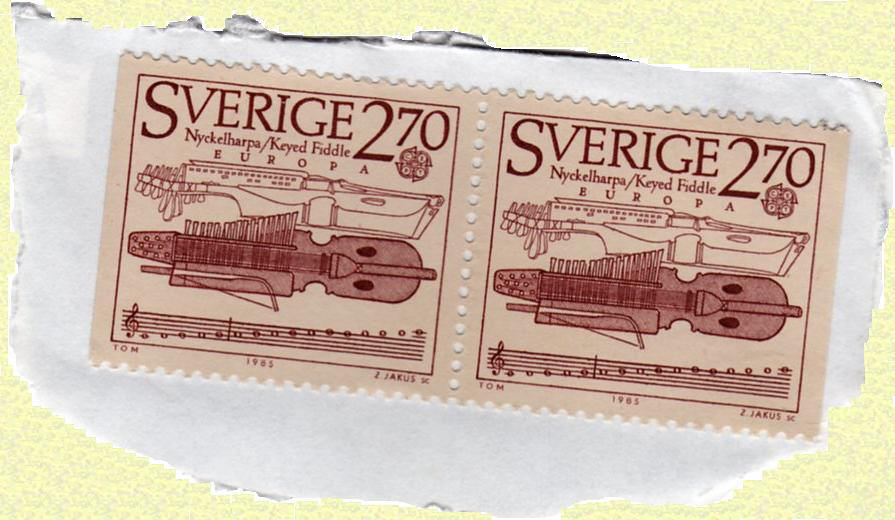
"Det låter som sommar", ”It sounds like Swedish summer” is a new CD with Ann-Mari and Sven Nordin from Haninge in Sweden. It is delightful music on nyckelharpa, an Old Swedish folk music instrument. The CD also features harmonica, zither, older versions of the nyckelharpa, old accordion, and piano. The CD is a musical memoir of our last twenty years as Swedish folk musicians.The nyckelharpa (sometimes called the Swedish Keyed Fiddle) is a special Swedish instrument.It has ‘keys’ that slide under the strings, each with a tangent that frets the strings to make the notes.A short bow is used. It can be traced back to at least the 16th century (one instrument is dated 1526).The very oldest indication of a nyckelharpa is a stone relief in the Källunge Church, on the island of Gotland, dated 1350.The oldest form of nyckelharpa was very simple, with only a few strings and keys.Today’s modern nyckelharpa has 16 strings, four of which are played with the bow. The other 12 are resonance strings (sympathetic strings). Usually there are 37 keys spread over three octaves, and is chromatic, though not all the sharps and flats are present at the very highest end of the first string. The accordion was invented in Germany in 1822. It was developed from a tuning pipe with bellows, used for tuning the pitch on church organs. The earliest and simplest one had only one row, and was manufactured in Germany from 1830-1840. In Sweden it was played as a folk instrument around 1840-1850. The accordion played on this CD has two rows but only the first was used.
About the tunes
1. Sorundamarchen is a wedding march from the village Sorunda in Sörmland, 20 km south of Stockholm. It is written down in Sörmlanska låtar, number 665, as Carl Arvid Rosenberg played it. Instruments; Modern nyckelharpa and zither.
2. Tegenborgsvalsen, after Wilhelm Tegenborg, 1840-1921, from Lölvstabruk in Uppland. The waltz is played on old type of nyckelharpa, mixed with other instruments like zither and harmonica.This recording features sevaral parts played by the same person, using modern recording techniques.
3. “En gammal gumma sjöng denna låten” means “an old lady sang this tune.” As you probably know, fiddle tunes were passed to the next generations by singing as well as playing. This waltz had a song text, nowadays forgotten.
4. Boda Polska is a type of tune that is played in Boda, Dalarna. Dalarna is considered by many people to be the stronghold of Swedish folk music. The tune is played on harmonica and zither.
5. Hamburgska i C-dur is a polska from Sörmland, played in C-major. Hamburgska is a common type of melody useful for dancing. Instruments; Modern nyckelharpa and zither.
6. “Leipzigs krigsmarch” means the march played in the Leipzig war, 1813. The musicians did certainly not play harmonica (it was invented 1821) but here you hear harmonica and bass-harmonica, with Ann-Mari playing the drum.
7. “Farmors hambo” (Grandmothers hambo). Hambo is a tune in ¾ time. I composed this hambo, sitting on a midsummer evening, playing around on my keyed fiddle. Suddenly Ann-Marie´s grandmother (90 years old) started to move her body in the hambo rhythm, and I knew I had made a good hambo.
8. “Gammelpolska” (old polska) is another of my compositions. When I did some repair work on an old nyckelharpa, owned by Wilhelm Tegenborg, suddenly this melody just appeared from the instrument. Its is in ¾ time but sounds more like ”regular” beat. This recording was done with a poor cassette recorder many years ago, with a fiddle that had gut strings and homemade rosin, that’s why it sounds so very old!
9. Polska efter Kalle-Svensk. Karl Svensk was an old nyckelharpa player who lived 1873-1937. There are many tunes called ”polska after Karl Svensk” -- this one is number 72 in Svenska låtar, Uppland. Ann-Mari is playing ”bodsekund” as it is called in Swedish, meaning ”farmers-second”, when one plays a second part with a ”bom-pa-pa” accompaniment. I (Sven) am playing on a reproduction of an old nyckelharpa, called ”kontrabasharpa med dubbellek” or Österbyharpa, since Kalle Svensk was from Österby in Uppland.
10. Boda polska from Dalarna, played on modern nyckelharpa and zither. The zither is an excellent instrument for accompanying bodapolska.
11. Dunderhakens vals. “Dunderhake” was a nickname used during the 18th and 19th century. “Dunder” means heavy sound, and may come from the fact that Mr Dunderhake was a former rock-blaster. He was also a good player of the old accordion. Viktor Vikman in Österbybruk, Uppland, played this waltz for me.
12. Polska i Arkadien is another of my own compositions. It could be translated as ”the polska played in Arcadien,” an old province in Greece on Peloponneos. The province of Arcadien is considered to be a country of tranquillity and innocent fortune.
13. “Svenne satt på taket” could be translated to “Sven was sitting on the roof.” There is an old Swedish folk song that goes like this: “Faderittan” sitting on the roof, “Faderittan” falling down, “Faderittan” did die, “Faderittan” is no more. The beginning of this composition sounds like that tune, that’s why it’s called ”Svenne (Sven) sitting on the roof”.
14. Stefan Hagling, who is a clever accordion, nyckelharpa and piano player, composed this piece, “Födelsedagsschottis till Sven” (birthday schottis for Sven). He plays mostly jazz and that has perhaps influenced him in this composition, especially the 3rd part. He composed this tune for my 50th birthday.
15. A march that Oscar Larsson from Uppsala played, but it is not known who composed it. It is very old and little like “march after Klas Harpare” in the beginning. It is on the video “Spelmän i Norra Uppland,” at the Music Museum in Stockholm.
16. Födelsedagshambo is my own composition. It is played here on solo harmonica and slightly influenced by Uppland polska. I won 3rd prize at a composition competition in Kärnåsen, Värmland in 1989 with this tune.
17. An old “vagnshusvals” from Österbybruk as Viktor Vikman played it on accordion when I visited him. But as he said, “this is a very old nyckelharpa tune.” It is here played solo on kontrbasharpa med dubbellek (Östebyharpa).
18. Gå’s Anders A-dur polska is a typical Uppland bond polska even if it is here played on harmonica and accompanied by Ann-Mari on zither.
19. Tranan, after Byss-Calle, is a typical slängpolska from Uppland. It must have been composed by Byss-Calle in the 18th century. Also on this tune you hear harmonica and zither.
20. Fermens Polska, or polska from Sörmland, is a traditional polska and sounds like slängpolska. There is nowadays a special dance for just this polska. Instruments: nyckelharpa and zither.
21. Kers-Lars brudmarsch is a tremendously beautiful wedding march played by me on nyckelharpa, both first and second parts, with Stefan accompanying on guitar. On many tunes on this recording, I have used “sound on sound” to make it possible to play a harmony part with myself.
22. Upplands-polska in E-minor, played by Ann-Mari on the piano. The piano was in the 19th century used to play polskas in fashionable salons and country houses.
23. Schottis after Kalle-Lind, Vigelsbo, Uppland is a typical Swedish schottis. Kalle played it originally on his C-major accordion but I have arranged it for my harmonica in A/D-major. I have also mixed it with a sound effect, making it sound like an accordion.
24. Vallåt after Henry Wallin, Stockholm. “Vallåt” means herding tune, and was traditionally used by women herders to call cows and communicate with other people using a special vocal technique called “kulning”. I play both lead and harmony parts, with Ann-Mari on zither.
25. Säg Lilla Kari is the first line in a song that is a typical song polska. Originally Henry Wallin played it in C-major on his violin, but when Ann-Mari and I tried to sing in that key, we found it impossible. Even when we transposed it to D-major (as it is played here) it is still impossible!
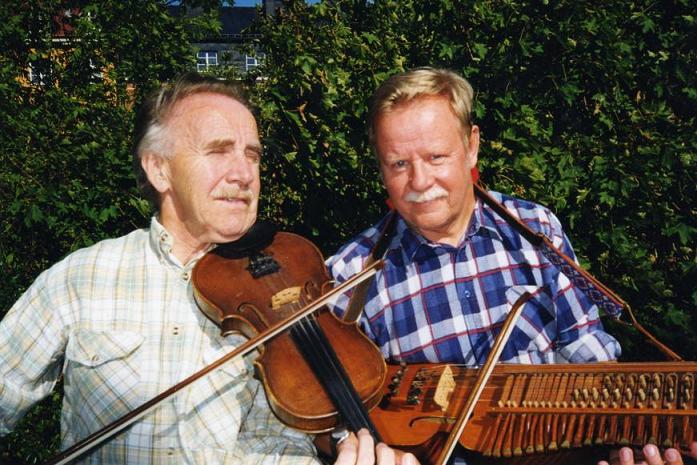
Henry Wallin och Sven Nordin
foto Birgitta Wallin
-------------------------
Nr 3 En gammal gumma sjöng denna låten.
Nr 14 Födelsdagsschottis till Sven
Nr 15 Marsch eft. Oscar Larsson
Nr 23 Schottis eft. Kalle Lind
Nr 24 Vallåt eft. Henry Wallin
Nr 25 Vispolska eft. Henry Wallin
-----------------------------------------------------------------------